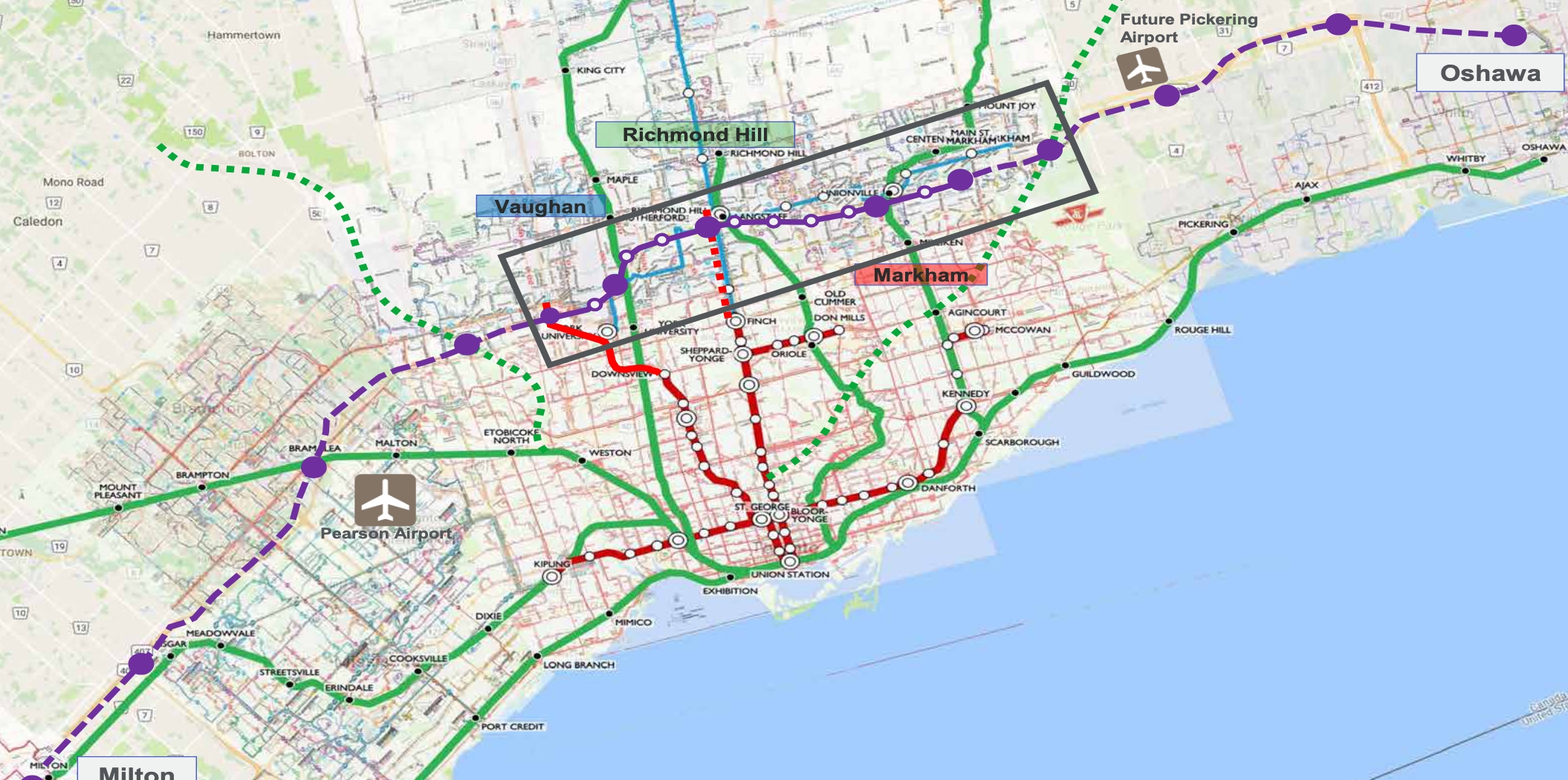
If you live in the Greater Toronto Area, chances are you’ve felt it: trips that should take 20 minutes stretching into an hour or more, not because of distance, but because of how the region is structured. The GTA’s transportation system was largely built to move people in and out of downtown Toronto. What it was never designed to do well is move people across the region.
As population growth has spread jobs, housing, and services east and west of the city core, this imbalance has become increasingly costly. Workers traveling between Durham, York, Peel, and Halton often have no realistic transit option. Driving becomes the default, congestion worsens, and productivity suffers.
This is where the idea behind the GTA Crosstown begins.
The Crosstown proposes a continuous east–west rapid transit corridor along Highway 407 — a route that already spans the region, connects multiple municipalities, and avoids many of the constraints of dense urban streets. Instead of forcing east–west trips through downtown bottlenecks, the Crosstown would allow people to move efficiently between regions, employment centres, and communities.
But the project is not just about speed. It’s about balance. A true east–west transit spine would fundamentally change how the GTA functions, reducing pressure on radial lines, shortening commutes, and giving people more choices about where they live and work.
Cities around the world that function well — from Paris to Tokyo to Seoul — have strong orbital or cross-regional transit lines. The GTA does not. The Crosstown is a proposal to finally address that missing piece and bring the region’s infrastructure in line with how people actually live.
